La trinidad sagrada del Almonteño: Rocío, marisma y Doñana.
«How beautiful is El Rocío, how beautiful is the marsh, and how beautiful is Doñana, my pride to be a marismeño from that Huelva marsh!». The lyrics of this historic sevillana sung by the marismeños and yegüerizos after finishing the job of regrouping the cattle they have in the wild and free Doñana perfectly encapsulate the idiosyncrasy of a town that cannot be understood without the Virgin, without Doñana, and without the marsh. A holy trinity that outsiders, as the Almonteños often call those from outside, will never comprehend or feel like they do.
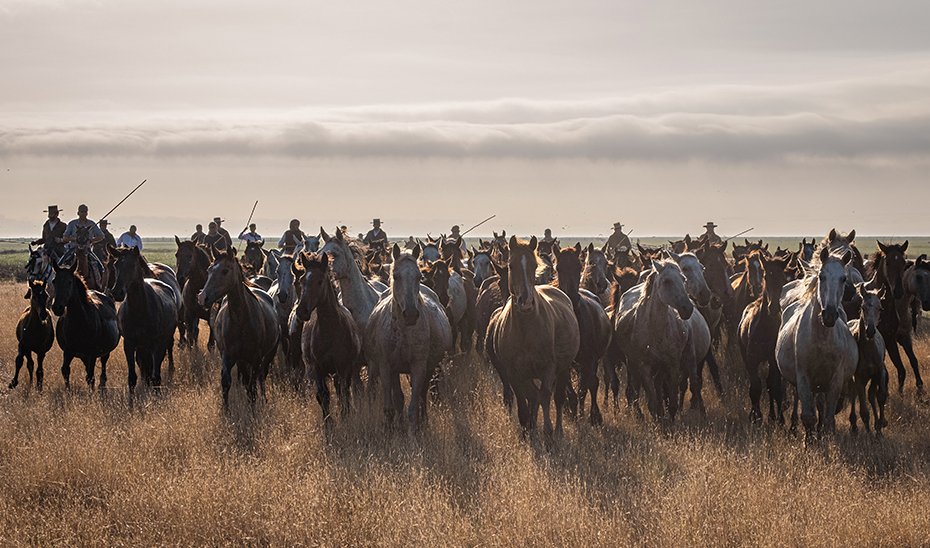
During the past few days, the yegüerizos have been in the territories of both the National Park and the Natural Park of Doñana, gathering around 1,300 mares of the native marismeña breed that they have in this natural gem all year completely free. Once regrouped, they move them from the marsh to Almonte, passing by the Virgin of El Rocío, in preparation for the livestock fair held in the town. There, they perform the usual tasks of grooming and trimming the manes, and of course, there is the buying and selling of animals. This transfer known as the ‘Saca de las Yeguas’ is always celebrated on June 26. After the fair, on July 1, the animals are once again led back to Doñana where they will remain free for another year.
These living conditions make this livestock very tough and strong when it comes to working in the fields or pulling a cart. The living conditions and the abrupt weather changes they endure throughout the year make them robust and noble. Many acknowledge that they may not be as visually attractive as other horse breeds, but the depth, strength, and resilience of these marismeño animals are unparalleled in other breeds.
Troops of mares in front of the Shrine of the Virgin of El Rocío (Photo by Antonio Delgado-Roig).
Although it may seem like a simple and easy task, the Saca de las Yeguas hides behind it all the feelings of a town and a way of life inherited from many centuries ago, specifically since 1504 when the Duke of Medina Sidonia formalized a tradition that had been celebrated for ages. Back then, the nature of this activity was much more economic than it is now. The mares were used for threshing, for working in the fields, and the ranchers bought and sold animals among themselves. Mares, males, foals, each one built their small livestock according to their needs.
Today, the activity is carried out to preserve a tradition and a way of life, and to teach the new generations a rural task just as they learned it from their elders, as modern agricultural machinery no longer requires the use of animals for many agricultural tasks. The organization is the responsibility of the National Association of Marismeño Cattle Breeders in collaboration with the Ministry of Sustainability and Environment, through the Doñana Natural Space, and also with the Almonte City Council, which participates in the journey of the animals from El Rocío to the town’s livestock enclosure.
This is explained by Gregorio Maraver, one of the partners of the entity. His father was the founder of this collective, and he eventually became president. During the siesta, after collecting their livestock the day before the yeguas are rounded up, he affirms that this tradition «is in their blood» and that, in addition to the field work involved in spending a day or two on horseback in Doñana and sleeping in the open, there is a «very important social component» which is the gathering of yegüerizos of which each is a part and that makes them feel that they are not another family, but their family.

Yegüerizos in Doñana on their way to their animals (Photo by Antonio Delgado-Roig).
It is also not an activity done for money. Most ranchers have few animals. «All of this ultimately costs money, coming here, spending a couple of days here in Doñana. Going, coming back, taking care of the animals. There is no economic compensation, quite the opposite, but it is a way of life and feeling of our town. We cannot live without this.»
Conservation of the ecosystem
Although it may seem otherwise, all the activity of the marismeño livestock is perfectly regulated. The animals are distributed in a total of ten farms within Doñana, and each of them has a maximum quota of animals. Foals do not count until they are one year old, but after that they do. And then the ranchers have to sell some animals if they have had offspring or leave them in stables in the town to not exceed the quota of each farm. This is where the conservation of the natural environment also comes into play. Livestock benefits from Doñana, and Doñana benefits from livestock. But everything must be in the right measure to not disrupt the ecosystems.
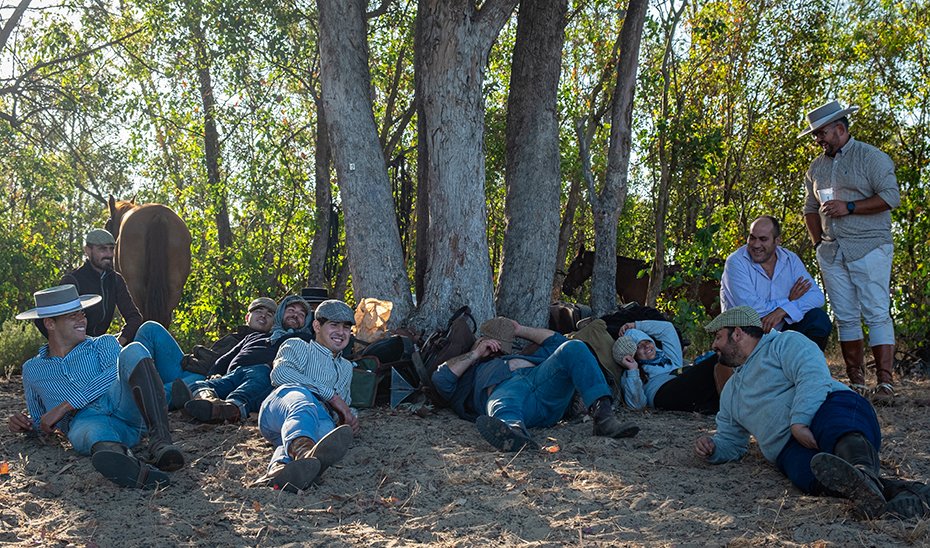
Yegüerizos resting after finishing the job (Photo by Antonio Delgado-Roig).
In the right measure, one must also know how to handle the livestock, and one must be an excellent horseman. These animals live in the wild, are not accustomed to the presence of humans, and have their own tendencies when it comes to moving. Rafael Bejarano, a 76-year-old yegüerizo, shares a glass of wine after a morning of work and recalls how, as a child, his elders taught him how to move the animals. «Some areas now have some fences, but before there was nothing. They would tell me to run on this side and not on that one because otherwise, it would be impossible to group them, and teachings like that I have passed on to others. As a kid, I would sit here, at the meetings, and listen to the elders talk, and that’s how I learned little by little.»
The work of the Park staff is also very important. Both Environmental agents and forest rangers are responsible for ensuring that everything is in order and that there is nothing that could indicate that the rules of nature conservation are not being followed. Javier Giménez, a ranger from Almonte, explains that this activity represents a «heartfelt relationship» between the natural space and the town. «Right now, they have finished their work, and there are grandparents, parents, grandchildren, children playing around the mares, learning and experiencing something they will never forget.»
And regarding the task they carry out, he explains that they have to be in charge of surveillance and control and that the activity respects all the rules and restrictions due to bird nesting, animal offspring, species in danger of extinction, etc. «Every task carried out here must be respectful of the environment, and we all must ensure that it remains so. There is control at the park entrance; no one can enter without accreditation, with name and surname. Each meeting has a maximum number of guests; everything must be preserved so that it is always in the right measure.»
Giménez also clarifies that this livestock activity is not only carried out around June 26, but the ranchers are attentive to the animals all year round. «It may seem very beautiful, which it is, but it is also very tough. During winter, they also come to check on the livestock. Many hours on horseback on cold days in the marsh. And this year, with a lot of water and very flooded areas, they also had many difficulties in reaching the farms and seeing the condition of their livestock.»
The yegüerizos are organized into a total of sixteen meetings, and from two or three days before the roundup, they start entering Doñana on their way to the farms where they have the livestock. It must be taken into account that the park’s surface area exceeds 54,000 hectares and reaching one of the farms where the mares are located can mean many hours on horseback. Once the mares are grouped in some of the enabled enclosures, all that is left is to wait for the 26th, but during all that time, there is that coexistence of each meeting where the singing, the memories of the elders, and the feeling that being breeders of the marismeña breed provokes in them, and all the activity that it entails, make them feel like the happiest men in the world during those hours.
Once the day of the 26th arrives, the work also begins at dawn. The livestock must be driven to El Rocío. It is a few hours from where they started. Most troops of mares go through the Boca de Lobo area to head to Sanlúcar Street and arrive directly at the Shrine of the Virgin of El Rocío. It is one of the most spectacular images and also one of the powerful tourist attractions of Andalusia.
Mares on the Los Llanos path on their way to Almonte (Photo by Antonio Delgado-Roig).
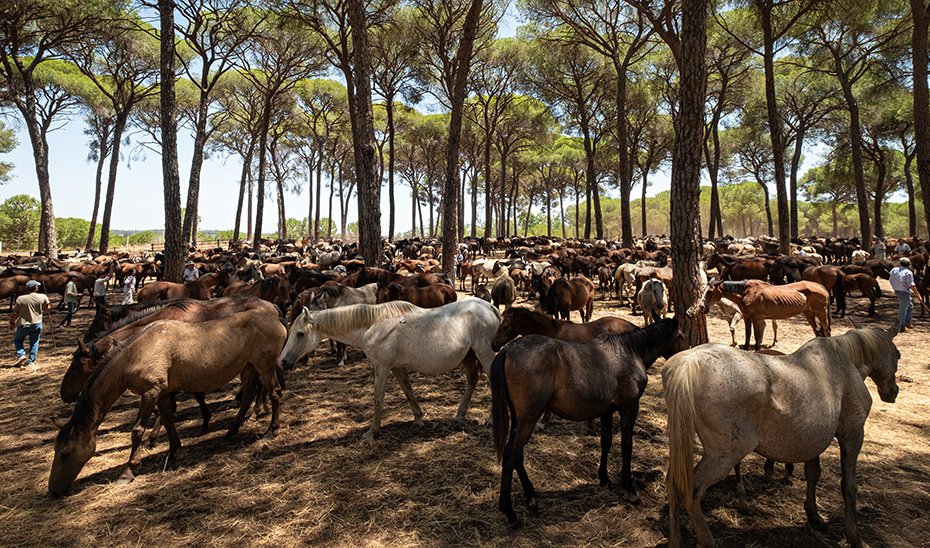
After leaving the hermitage, the troops of animals go by the Los Llanos path to Almonte and in the area of El Pastorcito, they have a long siesta and another moment of coexistence. The marismeña mares are in their enclosure under the shade of a lush pine forest while the yegüerizos also give rest and water to their riding horses. A few hours later, at dusk, the entourage sets off again on the way to Almonte.
Dress code rules
This is one of the most emotional moments for many of them, where feelings are brought to the surface, as Isabelo Pérez, another rancher from Almonte, explains what the Saca de las Yeguas means to them. «It’s hard to explain, but we have lived it for many generations since we were children. It is our way of life. Additionally, we make sure that the composure is always correct. The horses must be well-groomed in the vaquera style; we do not allow straw hats or baseball caps. The caps must be the traditional ones. The hats must be wide-brimmed felt hats, the usual ones, also made of rabbit fur. And the cowboys must wear a shirt; we also do not allow polo shirts even if they are cooler. This must be done like this because, if you’re not careful, in a few years, people here may start dressing in any way, and traditions must be preserved.»
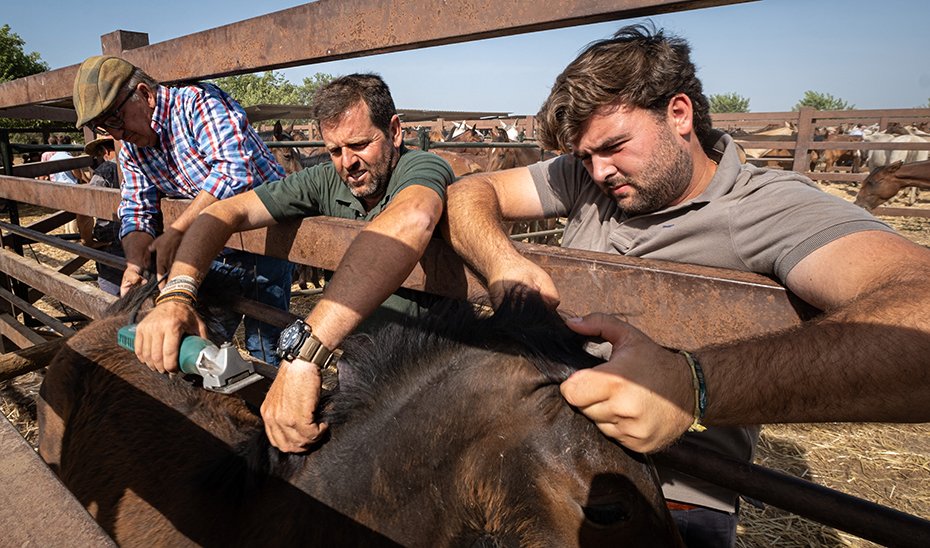
Ranchers performing grooming and mane trimming tasks (Photo by Antonio Delgado-Roig).
After the siesta and with the animals already in the livestock enclosure, the town of Almonte bursts with joy. They have once again fulfilled their centuries-old tradition, and after the fair, the beasts will return to the marsh on July 1. The holy trinity of El Rocío, the marsh, and Doñana continues stronger than ever.
TEXT AUTHOR: Antonio Delgado-Roig.
VIDEO AUTHOR: Rafael Aviles.