
La Junta destina 392.000 euros para la reparación y mejora de vías pecuarias del Plan Romero 2025
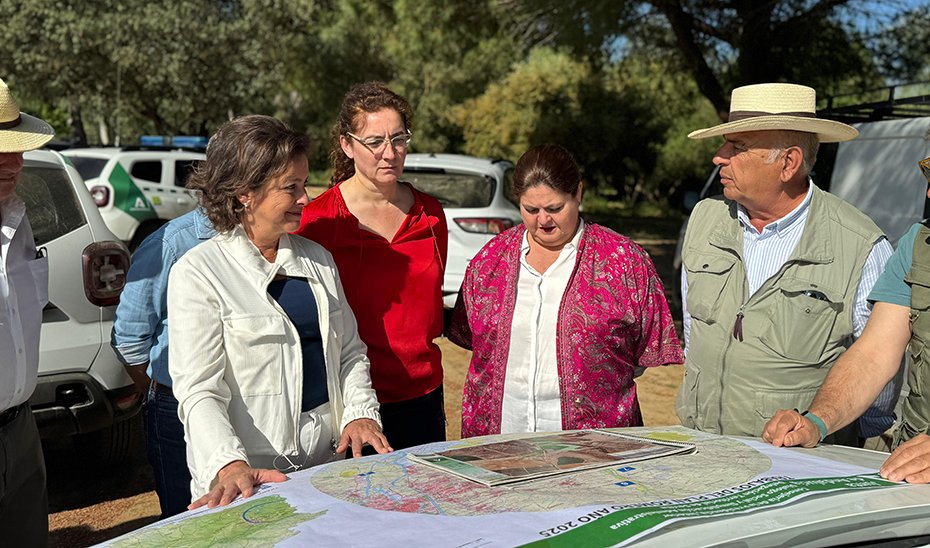
The Sustainability and Environment Councilor, Catalina García, has firsthand knowledge of the work being carried out for the repair and improvement of livestock paths and forest roads linked to the Plan Romero 2025. These actions, as a whole, amount to a total investment of 391,905.25 euros and will be completed in the coming days.
During her visit, the councilor toured several key locations for the operation, such as the Vado del Quema, the Cañada Real de la Isla, the resting and overnight area, and the camping areas located in the public forests of the municipality of Aznalcázar in Seville. These spaces are part of the most traveled routes by the brotherhoods that pilgrimage to El Rocío every year, making their proper conditioning a priority to ensure the safety and well-being of the thousands of pilgrims who cross Andalusian territory.
Catalina García was accompanied by the mayor of Aznalcázar, Manuela Cabello; the territorial delegate of Sustainability and Environment, Inmaculada Gallardo, as well as officials from the Plan Romero of the Territorial Delegation and environmental agents, among other attendees.
One of the main lines of action carried out by the Territorial Delegation responds to the need to restore the functionality of the most affected livestock paths by the so-called «storm train» of last March, which left more than 700 millimeters of accumulated precipitation in just three weeks. This caused significant structural damage to forest and agricultural roads. To address this situation, critical sections will be restored in municipalities such as Alcalá de Guadaira, Bollullos de la Mitación, and Dos Hermanas.
These interventions include tasks such as road surface conditioning, repair of bumps, gutter profiling, patching, clearing, and pruning on margins. These are essential actions to allow safe passage for pilgrims and animals on their way to the El Rocío village, while ensuring the accessibility of emergency services assigned to the Plan Romero, especially those of a sanitary nature.
Another noteworthy action is the silvicultural conditioning of rest and overnight areas for the brotherhoods in public forests, areas that require special preparation both to facilitate the stay of pilgrims and to prevent possible forest fires. These tasks are being carried out in around 100 hectares in spaces such as the public forests of Dehesa de Abajo, El Colmenar, Dehesa Boyal, El Chaparral, Los Montes, La Atalaya, and Ordenados de Aznalcázar.
The works, focused on grading, clearing, pruning, and enhancements, have also included the shredding of generated plant residues, facilitating their incorporation into the ground.
Actions in the vicinity of Vado del Quema
The most symbolic intervention of the whole is being carried out in the vicinity of Vado del Quema, an emblematic enclave of the Camino de Sevilla where the brotherhoods cross the Guadiamar River and where the traditional «baptism» of pilgrims who come to El Rocío for the first time takes place. This is an area of special relevance for the operation of the Plan Romero, due to its high concentration of pilgrims, animals, and vehicles.
In this environment, the work affects a total area of 68.92 hectares, distributed among the public forests of ‘El Corredor Verde de Aznalcázar’ and ‘Ordenados de Aznalcázar’. The actions include manual and mechanized clearing tasks, regrading, pruning, thinning of trees, and repair of the wooden fences that delimit the accesses and exits of the enclave.
These measures aim to improve the pilgrims’ experience, as well as reduce the risk of accidents and facilitate a possible evacuation in case of emergency, especially in situations of fire or large crowds.
Comprehensive improvement of the roads
Finally, the special effort being made to carry out the conditioning and improvement of an extensive network of livestock paths associated with the Plan Romero, once the land has been drained after the heavy rains of March, is highlighted. This intervention includes road restoration, margin revegetation, and the adaptation of strategic sections throughout various municipalities in the province of Seville, including Aznalcázar, Bollullos de la Mitación, Coria del Río, and Villamanrique de la Condesa.
The aim is to ensure safe passage during the main pilgrimage, as well as during the rest of the pilgrimages and celebrations that take place throughout the year around the devotion to the Virgin of El Rocío.
The councilor has stated that all these works were «designed with sustainability, efficiency, and institutional responsibility criteria,» and has affirmed that the Andalusian Government «has strengthened the operation for this year with the aim of ensuring that the journey to El Rocío takes place under optimal conditions, both from a safety and environmental respect standpoint.»
In this regard, Catalina García has emphasized that «work has been done in advance to prevent possible emergencies and ensure that the paths are ready on time, guaranteeing the safety of people, animals, and ecosystems that cross through.» Additionally, she has indicated that «the Plan Romero is not just a logistical operation, but a demonstration of the commitment of the Andalusian Government to our traditions, to the protection of natural spaces, and to the conservation of livestock paths as a living heritage of the rural world.»
The councilor has maintained that these works «have been driven by proximity, listening to the municipalities involved and working hand in hand with the brotherhoods, with the aim of improving the response of the Plan Romero each year and strengthening institutional coordination.»
On the other hand, the Minister of Sustainability and Environment has recalled that the Government of Juanma Moreno has invested a total of 67.7 million euros in the conditioning and improvement of livestock paths in Andalusia. Of these, 14.1 million have been allocated to the province of Seville. Thus, she detailed that the actions in the autonomous community in this area have involved the repair of 1,513 kilometers of livestock paths, of which 268 kilometers correspond to the province of Seville.

