
La Junta destina 20 millones a plantas de tratamiento de biorresiduos en Granada
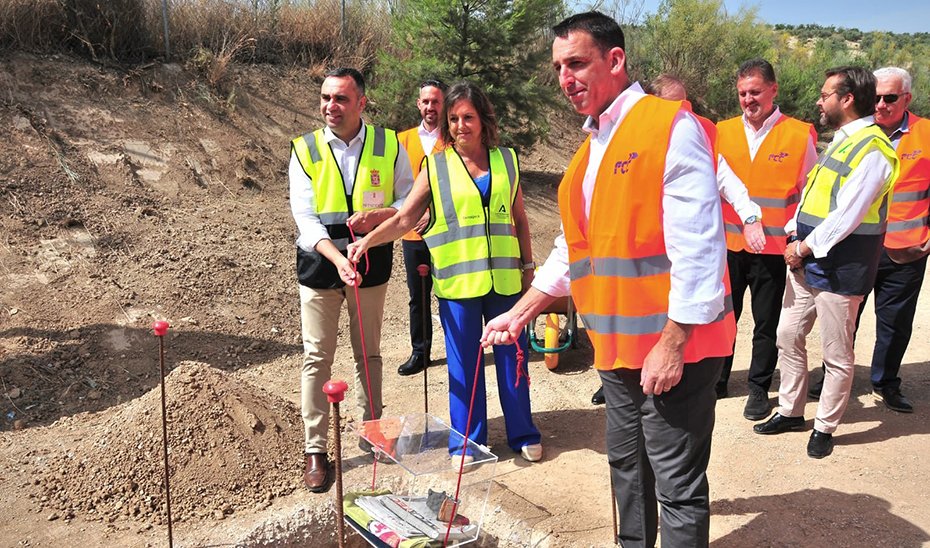
The Sustainability and Environment Minister, Catalina García, participated in the laying of the first stone of the new line for selectively collected biowaste treatment at Ecocentral Granada, in the municipality of Alhendín, promoted by the Granada Provincial Council with the support of the Andalusian Government. At the event, she announced a new direct grant to the provincial entity for the construction of an automated composting plant. The Andalusian Government has granted subsidies totaling 19.4 million for both projects.
Also present at the event were the President of the Provincial Council, Francisco Rodríguez, the Delegate of the Government of Andalusia in Granada, Antonio Granados, the Mayor of Alhendín, Jorge Sánchez, the Director General of Environmental Sustainability and Circular Economy of the Andalusian Government, Carmen Jiménez, the General Director of FCC Medioambiente S.A., Francisco Javier Irigoyen, the Territorial Delegate for Sustainability and Environment in Granada, Manuel Francisco García, and the Water Delegate, Antonio Mancilla, among other authorities.
The Sustainability Minister emphasized that this new public investment will allow the Granada Provincial Council to build a state-of-the-art facility that will significantly improve the treatment of organic waste, thus meeting the objectives set by the European Union. «We have decisively chosen to support local entities in transforming waste management and moving towards a more circular, low-emission, and sustainability-focused economy,» stated García, highlighting that «biowaste represents one of the main challenges and also one of the greatest opportunities in environmental matters today.»
The automated composting plant project, which will also be located at Ecocentral Granada, has a global budget of over 23.9 million euros, with 15.8 million being co-financed by the Andalusian Government through European NextGenerationEU funds, as part of the Recovery, Transformation, and Resilience Plan.
García explained that this new complex, which is expected to be operational by the summer of 2026, will process approximately 80,000 tons of organic fraction collected separately from all municipalities in the province. «We are talking about a decisive step forward in municipal waste management, which will allow us to reduce landfill waste, improve recycling rates, and obtain high-quality compost,» she pointed out.
Additionally, the Andalusian Government has granted a grant of 1,021,880.30 euros to the Provincial Council of Granada for the development of a compost refining plant at the Loma de Manzanares Environmental Complex (Ecocentral Granada), in Alhendín. This initiative, with a total budget of 1,766,645.45 euros, is part of the Recovery, Transformation, and Resilience Plan financed by the European Union. The project will enhance the treatment of selectively collected organic fraction, optimizing the quality of the obtained compost and promoting a more efficient management of natural resources.
In her speech, Catalina García emphasized the Andalusian Government’s commitment to promoting environmental infrastructure «that responds to regulatory challenges, generates green employment, and reinforces the role of the environment as a driver of provincial development.» The Minister added that this plant is a key tool to comply with Law 7/2022 on waste and contaminated soils for a circular economy, which requires organic matter to be collected and treated separately.
Tangible and Measurable Environmental Improvement
In addition to the composting project, the Andalusian Government also supports the new biowaste treatment line symbolically inaugurated with the laying of the first stone, with a grant of over 2.5 million euros, also co-financed with European NextGenerationEU funds, representing nearly 49% of the total project budget, amounting to 5.3 million. This initiative will optimize current processes for receiving and classifying organic waste at the source.
As detailed by the Minister, «the new treatment line will include improvements such as the expansion of the sorting hall, a new pit with a capacity to store up to 80,000 tons per year of biowaste, and an automated system to separate improper materials and recover valuable fractions that may come with the separately collected biowaste.» Catalina García highlighted that «all these efforts are part of an efficient, modern management model aligned with the principles of the circular economy.»
Both projects, both the pretreatment line and the automated composting plant, form an integral strategy to maximize the valorization of the organic fraction of household waste and avoid its disposal in landfills. The Minister stated that «these initiatives will bring about a tangible and measurable environmental improvement, positioning the province of Granada as a leader in sustainable waste management.»
She also praised the institutional collaboration with the Provincial Council and municipalities in the province, stating that «such alliances demonstrate that when administrations cooperate, major projects become possible.» In this regard, she congratulated the Provincial Council for driving these investments and for its role as a supramunicipal entity ensuring that all towns in Granada can meet European standards. «Granada is now an example of how well-managed European funds translate into real progress that improves the quality of life for citizens and protects our environment,» she added.
In addition to these two major projects, she highlighted that the Ministry has also allocated a total of 1.94 million euros for the improvement of the Mechanical-Biological Treatment plants in Alhendín and Vélez de Benaudalla, also processed by the Granada Provincial Council.
Measures for Waste Management
García also mentioned the Andalusian Government’s commitment to improving waste management and supporting municipalities in this task, stating that «we have provided grants and investments totaling 166 million euros for the implementation of effective collection and treatment of municipal waste.» She highlighted the Andalusia Clean Points Plan, «which will bring to life 12 new facilities of this kind, with a budget exceeding seven million euros,» the Transfer Stations Plan for Biowaste, with a allocation of four million, and the various aid programs for separate collection of biowaste worth 45 million euros, with additional aids amounting to eight million.
Additionally, she mentioned the incentives for the acquisition of biowaste collection vehicles, amounting to ten million euros, those for treatment facilities and infrastructure improvement, with two lines of 36 million euros each (for the construction and adaptation of biowaste treatment facilities), and another two lines, totaling 21 million, for the improvement of mechanical-biological treatment facilities (TMB) or grants, totaling 35 million, for the construction and adaptation of biowaste treatment facilities, which she considered crucial.
In this context, she highlighted the significant increase in the Andalusian budget for this year: «In 2025, the budget allocated by the Government for the circular economy and waste management has increased by 68% compared to the previous year, reaching 137.9 million euros.» Finally, she noted that the regional government is promoting Local Circular Economy Plans and has activated new grants totaling three million euros for their development.

